About association
Our achievements
History and objectives
The first euroregions (unions of border regions of neighbouring countries) were created in Europe with the aim of restoring mutual trust between neighbouring nations and communities affected by World War II, reduce mutual grievances and simultaneously developing more peaceful international understanding, democratic values, social and economic structures, environmental protection, transport links, economies, while educating the younger generation.
Lithuania (administrations and municipalities of Marijampole and Alytus counties), Poland (former Suwalki Voivodeship) and Belarus (Grodno Region Executive Committee/Administration) on June 6, 1997 established the Union of Border Regions of the Republics called "Nemuno euroregionas" (Nemunas Euroregion). Later on, the administrations of Vilnius and Białystok counties and their separate self-government units were accepted into the Union. In 2002, 5 eastern districts (Ozyorsk / Darkiemis, Gusev / Gumbinė, Chernyakhovsk / Įsrutis, Krasnoznamensk / Lazdynai, Nesterov / Stalupėnai) of the Kaliningrad Region of the Russian Federation were also accepted.
The Nemunas River, which gave its name to our union, geographically and historically connected these lands, peoples and communities living in them.
The main objectives of the establishment and operation of the Nemunas Euroregion:
- to promote peaceful cooperation based on mutual respect and benefits for the development of border regions, improvement of the living environment and, at the same time, the quality of life;
- to create better conditions for the social and economic development of the regions, using cooperation between the countries' border regions and institutions.
This cooperation was partially financed by a cross-border cooperation programs established and supported by the European Union, as well as by the national, regional, district, and local budgets of neighbouring countries, and individual organizations or private individuals. Cultural or other social neighbourly exchanges carried out by non-governmental organizations and/or private individuals have in most cases been positive for the goals of the Euroregion in a broad sense. Meanwhile, deviations in the management and distribution of funds of "European" programs significantly soured the real cooperation, and even almost destroyed it. This is especially applicable in situations with the so called "one-day partnership" cases, especially those with abundant infrastructure, especially in ruling districts, with big names, received more support. Institutions with long-term, respectable and promising regional cooperation often did not receive funding for strategically important projects for regional communities, and it was justified by formal decisions with non-essential methodologies and scores. This pushed people and organizations out of the structures of true neighbourhood cooperation, introducing ever-increasing amounts of funds, but not cooperation, and into the "sharing" of program funds.
Not only the greed of certain persons, but also ill political will often hindered neighbouring Euroregional cooperation. This happened in various periods, but especially in the last year, the selection of projects for financing began to be more influenced by certain unfriendly interests of national political groups, blocking of relevant institutions and projects, restrictions on human exchanges for cooperation in the projects of the intended programs.
The quality and possibilities of cooperation were influenced by taking into account the intentions of individual national and/or regional political or political economic power groups formed at the time, for the relevant period.
In Lithuania, Latvia and Estonia, as in the countries of the Eastern Bloc, the national authorities have never agreed to even partially decentralize the programs for cross-border cooperation and give the euroregions the rights of administrators of these programs - the same situation was in the euroregions and border regions of Poland and the western countries.
Active euroregions and their institutions and the principles of healthy neighbourly cooperation was hindered both by fund "seekers" of funds, and politically biased structures. The concept and aspiration of "Friendship of Nations" was perceived as an object of ridicule.
In the long run, the abundance of cases that no longer correspond to the goals and principles of euroregional cooperation reached its peak - the euroregions of Lithuania and neighbouring countries began to be closed. Currently, only Nemunas remains in Lithuania; by the way, it was the first in Lithuania and the Baltic States in 1997.
Members of the Union of Border Regions "Nemunas Euroregion":
In 2004, the parties agreed that the members of the Union of Border Regions "Nemunas Euroregion" shall be the national (country) institutions coordinating the activities of the Euroregion:
• In Lithuania - Public Institution Nemunas Euroregion Marijampolė Bureau and its shareholders/members (from 2022 these functions will be taken over by Association "Nemunas Euroregion" with headquarters in Marijampolė);
• In Poland - the association "Euroregion Niemen" (headquarters in Suwałki) and its members;
• In Belarus - the Executive Committee of the Grodno region;
• In Kaliningrad region (Russian Federation) - 5 districts: The executive committees of Darkiemis / Oziorsk, Gumbinė / Gusev, Įsrutis / Cherniachovsk, Lazdynai / Krasnoznamensk, Stalupėnai / Nesterov (common headquarters in Cherniachovsk / Įsrutis; these functions were earlier performed by the Regional Development Agency "Nadruva" on the basis of the agreement with the Cherniachovsk / Įsrutis district administration).
National structures
The parties agreed that each, in accordance with its legislation, will establish the national structures of the euroregion for the coordination of this cooperation within the country and with neighbouring regions.
The Lithuanian party founded the public institution - Nemunas Euroregion Marijampolė Bureau in 1998, and its founders and first shareholders were the municipalities of Marijampole district and Marijampole City. Gintaras Skamaročius was invited to become director of this institution, he was also a member of the executive committee of the Association of European Border Regions in 2000-2012. Later on, the rights of shareholders were granted to various municipalities of Marijampolė, Alytus and Vilnius counties, which made relevant decisions.
Members/participants of Nemunas Euroregion Marijampolė Bureau (in 2021): Municipalities of Alytus city, Alytus district, Birštonas, Kalvarija, Kazlų Rūda, Lazdijai district, Marijampolė district, Šakiai district, Trakai district, Vilkaviškis district.
In one of the press interviews, we mentioned that:
"It all started with very small projects
Nemunas Euroregion Marijampolė Bureau was established to coordinate all cooperation activities on the Lithuanian side and with the border regions of neighbouring countries. Its director Gintaras Skamaročius remembers the beginning of his work as follows:
“If, at first, we talked about learning, establishing new relationships and maintaining contacts on both sides of the state borders, then later, when the opportunity to use finances appeared, we started using these opportunities for joint projects. We started with very small projects. The Marijampolė office of the Nemunas Euroregion, we received the first support funds in 1998-2000 for projects aimed at gaining experience in one or another country. We sent there architects, environment experts, representatives of municipal administrations. They went to Denmark, Germany, Holland, and Hungary to see how those countries live, cooperate, and implement projects. The sums were relatively small, but through those small projects we learned how to implement them, what happens when you do something wrong... Later, we had a project of the PHARE program, which helped our institution to purchase computers, because at the beginning we had to work with borrowed equipment, borrow money for bus tickets or fuel...
From roads to hospitals
Gradually, the number of projects increased, and the projects themselves became increasingly larger in scope.
- From those small projects, we made progress to the point where we simultaneously implemented 10 projects for several million euros. We successfully completed everything, we achieved all the desired results and significantly exceeded them, except for one case with the border roads of Lithuania and Poland. In 2005, when planning the project, we planned to make 12 roads, and almost 3 years later, after signing the support agreement, money according to the 2008 the prices of the works were only enough for nine. While waiting for the support contract, funds and the Government's decision, the prices practically doubled.
Two prepared projects of particularly high value and volume (4 million euros each) were intended for the hospitals of Marijampolė, Alytus, Tauragė, Suwałki, Białystok, Įsrutis / Chernyakhovs, Tilžė / Sovetsk, and other hospitals. One of them is the strategic project of the Lithuanian-Polish program, the other is the cooperation project of the medical institutions of Lithuania, Poland and Kaliningrad. Marijampolė Hospital took the most active part in the implementation of these projects and received the biggest share of support both for employee training and for the purchase of various medical equipment, an ambulance car and for the repair of premises."
The project activities of Nemunas Euroregion Marijampolė Bureau are well reflected by several numbers:
• about 1900 persons received training;
• around 50 different publications were published with a total circulation of more than 130 000 copies;
• over 130 video surveillance cameras were installed in 6 cities and districts for the safety of tourists;
• the documentation of Šešupė River water tourism routes was prepared;
• 7 "empty field" zones were prepared for investment;
• for own institution and other institutions together with partners, more than two hundred projects were prepared and/or implemented for the value of more than 27 million euros;
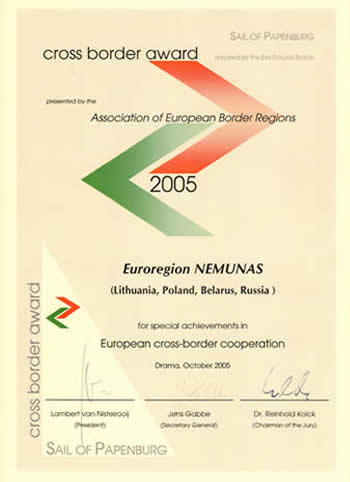
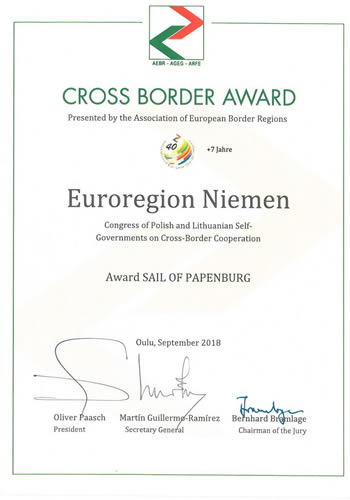
Three projects in 2005, 2012, and 2018 were rated among the best cross-border cooperation projects in Europe, and the renovation project of Kalvarija Royal Park was the fastest implemented in Lithuania.
It is also worth to mention non-project activities, e.g. the organization of economic exhibitions and investment forums in Alytus and Grodno (21 annual exhibitions were held in Grodno until 2019, which were attended by representatives from dozens of countries), the congress of Lithuanian and Polish municipalities, support for Lithuanian education and cultural heritage, Lithuanian communities, youth and other exchanges to cherish the memory of Kristijonas Donelaitis, Herkus Mantas, Martynas Mažvydas, Antanas Baranauskas, and other prominent persons of our nation.
Changes
After the Lithuanian court adopted a decision that the shareholders of a public institution are not obliged to comply with the decisions made at the general meetings of shareholders and may not finance the non-profit activities established in its statutes, as well as after consideration of other political decisions, and in order to preserve the possibilities of neighbouring/euroregional cooperation and the continuity of international projects, PI Nemunas Euroregion Marijampolė Bureau and other persons in 2021 founded the Association "Nemuno Euroregionas".
From 2022, it intends to continue the functions carried out by the Nemunas Euroregion Marijampolė Bureau in the Union of Border Regions "Nemunas Euroregion", together with other advanced partners of the public institution and association, and will take care of the coordinated continuity of the projects.
The Nemunas Euroregion Marijampolė Bureau and from the end of 2021 - Association "Nemuno Euroregionas" (with the same head manager and employees) prepares and continues/implements human resources, cultural exchange, tourism, health protection, strategic planning, business, environmental protection projects mostly covering the territory of the Nemunas Euroregion, advises municipalities and other institutions on the issues of project preparation, implementation, and international cooperation.
Because of the hindering cooperation with the partners of Belarus and the Russian Federation and increased opportunities for cooperation within the European Union, together with the Euroregion office in Suwałki, Association "Euroregion Niemen", we started preparing and initiated the creation of a new structure - the European Grouping of Territorial Cooperation (EGTC) "Nemunas-Niemen" Limited.
But, ... the idea of creating this group and jointly administering a part of the Lithuanian and Polish support program for the entire border region was not welcomed by the individual shareholders of the public institution - municipalities. For this activity, hostility came from the newly created so-called border functional zone, which hoped to receive and share program funds among themselves - 3 border municipalities with partners on the other side. Hostility also came from larger municipalities on a provincial scale which sought to participate in the establishment of this group by closing the public institution and share the support for the region in a smaller circle.
In 2021, in Lithuania, competition and consideration of the same value principle has intensified - the support for the entire border region according to a clearly defined strategy and needs, democratic principles and independence from the partisanship of individual participants, or support and the right to share it for a couple of municipalities - individualistically selected ones.
The "neighbours" in the eastern countries also had their say. In 2018, Gintaras Skamaročius, director of the Bureau and chairman of the Council of the Union of Border Regions "Nemunas Euroregion", was recognized by the national structures of the Russian Federation as dangerous to the armed forces and national security of the Russian Federation, and he was banned from entering the countries of the Eastern Bloc for 5 years.
This made cooperation with these countries difficult, but in the years of 2019-2021, mostly with the efforts of the Nemunas Euroregion Marijampolė Bureau, we implemented a joint project "Cultural heritage at border region - for tourism and cooperation" with Šakiai district administration and the Museum of History and Art of the Kaliningrad region. Its budget is around 1.1 million euros from which the program part is almost 1 million euros. By the way, the project was partially financed by the cooperation between Lithuania and Russia across the border in 2014-2020 programme and its partners.
Gintaras Skamaročius, director of Association NEMUNAS Euroregion
Asociacijos Nemuno euroregionas (VšĮ Nemuno euroregiono Marijampolės biuras) projektų partneriai (1998-2021):
Lietuvos partneriai:
Lenkijos partneriai:
Rusijos Federacijos / Karaliaučiaus srities partneriai
Baltarusijos partneriai
Kitų šalių partneriai:
Informaciją dėl vizų gavimo galima rasti čia: